Practice as Research and Publication.
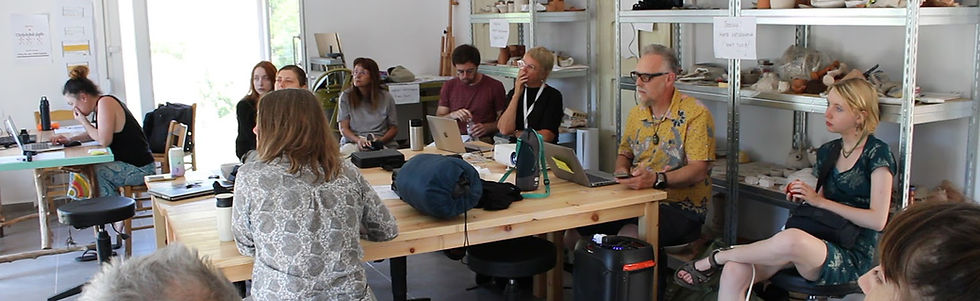


My practice as an artist is synonymous and indeed a vehicle for my research. Working as an artist is a journey formed from questions, fascinations and provocations that, for me at least, only have creative strategies to explore. It forms a connective fabric for me, across disciplines and very often in collaborative settings. The process is organic and reciprocating inasmuch as my practice will lead me into context and theory and that research study leads back to new questions that my artistic practice needs to engage with, look at, turn around and consider. It is therefore messy, often multi-faceted, but through the centre of it I can discern a clear line of discourse that has stretched back through decades now, which is in a state of constant change and only ever opens up before me. Research practice in the arts is also beautifully mysterious because we are rarely pursuing a hypothesis as such and there are aspects that would lose their power if they were directly explained or made visible. So things take time to emerge through reflexive consideration, journals, talks and writing that tend to look in the rear view mirror in order to discover a road ahead. Much of my research is evidenced through the discourse of my artistic practice in all of the sections of this website. In this respect this section will intend to provide a listing of that work in more formal outputs and a critical exegesis of my most current critical focus on the materialisation of nature through walking (see below). Not many of these outputs are separable inasmuch as they cohere as a collection of interdisciplinary projects that stretch back across three decades and more. Finally, this new version of my website remains in construction and the current iteration will provide itself a critical deadline of the end of 2027, in line with the Research Excellence Framework schedule .
Exegesis 2026
Creative Ecologies: Walking, Artisanship and the Practice of Material Attention
1. Evolution
My research emanates from walking. Walking, it seems to me, is our oldest technology of civilisation, the root of our understanding of the natural world and our grounded relationship to it. Walking is our contact with the ground, its surfaces and features, its inclinations, geologies and topographic qualities, its creatures, including ourselves, and its flora. Walking, if anything, was the cause of our primacy as a species and not the brain – this development, fed by protein, came later. We walked along coastlines, through forests, over mountains, across deserts and as we encountered the materiality of the earth and the plasticity of those resources, so we developed creative technologies of use from them – tools, structures, clothes, transportations, containers.
Our legs are perhaps our most impressive asset and as such we are built to walk huge distances. I wrote about this as a framing section of my PhD, with one key influence being the work of Francesco Careri in his book Walkscapes (ADD CITATION)
Over the years my research practice with walking shifted in focus from its initial exploration of how flight from conflict, from one country to another, impacted on constructions of language and identity, which had led to my PhD study. Following a good deal of works in theatre, sited performance, durational installation, illustration, creative writing and publication over 20 years, my focus naturally shifted from journeys that people felt compelled to make to why people would choose to make endurance based walks such as pilgrimages. There was still a crucial component of transformation in the contexts of identity but also now contexts of spiritual wellbeing. However, the vault face of this are the impacts on the body; exhaustion, muscular and skeletal and I also published with that focus. I began teaching young people how to navigate and hike through the Scouting movement and as a Duke of Edinburgh Award manager and at this point qualified for my Lowland Leader award with international Mountain Leadership.
2. Materiality
In the previous years since covid, notions of materiality arose in the research for four core reasons:
i) In DofE leadership training, an aspect, required also for expeditions, is the observation of natural features, not just landscape but flora. I read, learned and began to apply a good deal of knowledge around the notion of natural navigation from writers such as Tristan Gooley, Robert Macfarlane and Nan Shepherd. I began to teach this reading of the landscape to young people as an additional aspect of navigation that developed micro observations beside the macro experience and shifted attention interactively from mapped representation to elements of natural reality that reinforced ‘placeness’. This developed a realisation of ‘communitas’ as I saw their developing interest in the finer details of plants and features ordinarily ignored;
ii) Training young people for the Cheshire Hike is an annual event – we hike out over a two to three month period preparing and training for the final event that had always taken place around Easter. Since Covid, shifts in climate became very clear with our traditional routes becoming a quagmire during that period of the year. As a result the Cheshire Hike event itself, which involves 800+ young people, was moved until late September. Our training hikes became a measure of change in the micro-observation of flora and landscape – we saw differences in crop success, flowers and even trees in the height of heatwaves. Therefore I began to consider the relationship of this materiality to a young person’s perception, and sense of agency, in Climate Change;
iii) As an artist I have always rather helplessly been an interdisciplinarian, despite the lent of the academy, as it were, to train towards mono-disciplines. As an autistic adult, my interest lives in the connections between things and their relative or proximate qualities. This also means that in a productive artistic discourse a subject will suggest to me the material means for its production. There is a theory from my training as an art student that stuck profoundly, called ‘Truth to Materials’ – this concept permeated art production, perhaps beginning with the Arts and Crafts movement but certainly being championed by the Bauhaus, and it speaks to the relationship of material to its concept and the notion that its properties should not be disguised. (FIND CITATION). Over years of making work about walking this sense of materiality arose and I became interested in the ‘usefulness’ of the surrounding environments. This naturally developed a fascination for traditional skills using natural materials and as such, often working with young people, I developed my skills and interest in wood carving (which I had always done actually), pyrography, leatherwork, leather moulding and saddle-stitching and then also cordage, rope-making, Sashiko embroidery, willow weaving and basketry.
iv) During the Covid period I had built a knowledge of home recording, constructing 18 podcasts for Scouts who were no longer able to attend weekly sessions. Towards the end of Covid lock downs we were able once more to travel regionally, particularly on walks. I engaged in conversation with a friend who is an Anglican priest about performing an old Saxon Pilgrimage called The Two Saints Way and developed this idea into the concept of a discussion over the week of walking. Along the ways I used my newly developed audio production skills to create recordings and began to develop this into an audio walk paper (now published with Walklistencreate.org ). I subsequently developed a module option for Drama students at LJMU interested in Audio Drama, Audio Books and Podcasts and over a couple of years helped them to produce around 20 works for the public domain. I then travelled to Greece in June 2025, to meet with the Walking Artists of the WALC project, that I had only ever worked with virtually, and deliver a set of Walkshops introducing and developing audio recording skills and then conducting field recording walks together. What emerged for me though was a realisation that this approach was rather telescopic, containing both the macro layers of the landscape, its climate, features, depths and then the micro magnifications of insects, footfalls, rocks, textures and water. In its way then, and by the stripping of the other senses, it again leaves us with the impression of a great and complex materiality in nature.
3. Climate and Environment.
The process of a shift in attention from the body to the material environment walked through, both as a reading, in respect of natural navigation, and as a resource, in respect of foraging and making, also shifts our attention to changing features – water levels, cracked earth, quagmire paths, abundance and its opposite, fruiting and crops - in correlation to seasonal norms that we have experienced throughout our lives. I argue that familiarity formed by walking in landscape, in addition to the telescopic modes mentioned earlier (looking more closely) form both a deeper relationship and a phenomenally experienced sense of change that becomes something 'known' in the embodied sense of experience: temperature, texture, colour, abundance, use, taste, smell and of course what is missing, all form a part of this knowledge. Walking, then, is the technology by which we literally ground that experience, whilst making brings us into tactile contact with the materials of nature where the only processing is through the contructive skilling and processing of our hands. I argue here that his close, intimate engagement and practice of artisanship forms agency for young people that develops both a sense of responsibility but also the knowledge that they can intervene in consumerist culture and assert control over their creative use of natural resources.
4. Evolving Output
The building of aspects of this website constitutes the heart of documenting my work in developing artisanal skills to explore the development of material attention that arises in my walking practice and to form strategies for the consequent engagement with young people and adults. I am beginning to be asked for example quite broadly to visit groups, and individuals, and deliver willow weaving workshops.
4.1 WALC - Ropewalking
As part of my work with WALC (Walking Arts and Local Communities) and the Walk Listen Create international Supercluster, I have delivered workshops online with engagement literally across the world from artists who are invested in walking practices and to open up this discussion of materiality. Following 'walkshops' in Psarades, Prespa with WAC25 in June 2025, I delivered a talk and wallkshop in June 2026. My specific workshop was titled Ropewalking; Landscape, Plasticity and Making and introduced this discussion of materiality by both considering some of the lost and old skills or technologies of making that came from a foraging of natural resources, a look at specific indigenous examples and then discussed the relative space between artist and artisan which is occupied by this virtuosity of manual skill, processing and construction . Ultimately then it shifted towards inviting the participants to consider how they would engage in materiality and, in our synchronous walk at the end, they developed some beautiful physical artefacts in response from materials encountered:


4.2 Audio Walkshops
In September of 2026, I followed the Ropewalking delivery with an evaluative talk for the new WALC 7+7 project that will take place in Prespa in 2027. 7+7 is a project that will ask 7 artists and 7 members of local communities to choose 14 locations in the landscape that hold significant meaning for them. We will then map these as locations for walking and delivering works in response to the contexts that these 14 people supply. Places may hold historical, natural, familial or psychogeographical significance for example. In my evaluative talk, again to a worldwide gathering from Australia to Los Angeles, I presented the work that I made using Audio-walks at Prespa last August, and discussed the findings of this working across a number of key points from reflective analysis. The presentation was useful way of structuring thought into a final audio -paper that I will place here and publish shortly with the international group. Reflectively, my analysis of their recordings formed four distinct categories of artistic engagement in the 'audio' landscape:
i) The Macro and the Micro returns me to a telescopic mode that has followed me for years in my reflection of landscape as both something real, experienced and respresented. The macro of course relates spacially to everything within the scope of our senses - our awareness is drawn to layers of sound that describe distances, weathers, movement, machines, creatures, habitation and even topologies. Artists were asked to consider recording 'wildtrack' to create atmospheric backdrops whilst in our workshops but there was a playful tendency to shift from everything that engulfs our senses in the outside world to close into the tiniest moment. This was the micro then and the artists, like detectives sought the most delicate, proximal and tiniest auditory experiences. This is helped by headphones naturally because we are at once returned to a more internalised experience of sound. Current aural technology brands recognise some of the dangers of losing that broader awareness which is why companies are now promoting 'open' earbuds aimed at people such as runners and allowing the retention of that broader spectrum of focus. But for our part this attempt to capture the minutia of the world also represented that shift in what Stansilavski referred to as Circles of Attention (CITATION HERE) from the third circle (everything) to the second (just ourselves together in dialogue and communitas) to the first circle (just a self awareness born of hyperfocus on an object. My early years of teaching and publishing in theatre bought me back to this truth but I think also, as an autistic artist, it is a factor that is inherent to my practice because manual production of the object returns one to oneself and there is wellbeing in that. This is also how it is in walking - we step and our attention shifts gears through a breathing in of the broader landscape, a reflective dialogue or sharing with others and then also an investigation of smaller details that is also more relative to our our own more internal engagement of intrapersonal communication.
ii) Landscapes as Soundscapes: Whilst the micro and the macro might be considered an umbrella for everything that follows here, I have kept it as a distinct category because it also represents a choice that was present in all of the artists' recordings - this shift in foci was something held instinctively in common. The second distinct category of recordings were indeed those soundscapes: attempts to more broadly grasp and express the scale and distance, the heat, the life and the of the immediate region - lakes, mountains, dried grasses, birds, bears, people, dogs, machines, passing insects... In these we hear the journey of footsteps but also in the shifting timbre and production of space; things that are distant approach or pass, conversations do the same, life is described as directional and existing at a variation of auditory planes. In discussion afterwards artists discussed the playful joy of hearing this world through headphones and the recordings, intended often, as I mentioned, as wildtrack extended hugely beyond the single minute of so that is technically required for that! The soundscapes also paint a moment - they are the closest thing to the composite material experience of being there and much more so than an image because of that quality of distance, complexity, life, weather and so forth. There was joy in this then and in these recordings is a phenomenological index to what we experienced, playfully and creatively together, during those days. I was deeply touched by this. Again there is a measure for change in the auditory experience then because these recordings say 'this is how it was in that moment'.
iii) Dialogues: Those previous sentences strike me also as testament in quality but of course there is subversion in the isolation of qualities and these choices are exactly what defines work as artmaking. In that second circle mentioned above was a deliberate engagement with one another - the artists worked in pairs, most usually having only met in the previous day or two and coming literally from across the plant; I believe we had representation from most continents at WAC25! But we knew how to walk together and in this moment there was also an invitation, given in my Walkshops, to talk and record dialogue, to interview perhaps. This did not necessarily mean a dropping away of the material landscape but rather a discussion of their engagements as artists within it. I didn't deliberately provide provocation for these discussions in any way and what emerges are vibrant encounters that consider walking as a practice, contextual histories and ancestors, the landscape explored, war and freedom of movement, human evolution, home. I had realised in my first published audio-walk along the Two Saints Way how the repetition of one foot in front of the other with a companion provides the beat of a conversation - lots of things happen: we shift our proximities, try to walk side by side, look ahead rather than eye to eye, listen, share and think aloud. Their is often humour but usually, it seems, agreement and communitas - a shared experience of walking develops a sense of mutuality, often a genuine curiosity and a wish to reach common ground.
iv) Textural Experiment: The fourth category of recordings are happily abstract. I say so because they are distinctly playful and do not attempt any complexity of spatial layering or narrative. They are not purely sound effects and not archival inasmuch as they don't capture sounds naturally 'caused' within the landscape as such, but they do engage in it's material quality directly. These sounds seem to be experimental and textural in quality - rolling stones, rapping surfaces, sploshing water, rubbing materials together, clanging things. They are repetitive and speak of a close fascination directly conversant with the technologies at hand and the clarity made possible by close and detailed recording. These are the moments where all of the artists purely explore the medium, playfully and without artifice. These sounds originate also with the artists material engagement in the landscape. There is also a truth to materials of course because everything employed in the creation of these textural experiments is encountered and subsequently materially explored during the walk.
All of this felt important and I think it took a year of listening and considering to realise that the same engagement with the materiality of walking was present here as in my emerging research concerning old and artisanal skills. I have realised, and concluded in this international platform, that there was a natural co-production of sound with the material production of walking because the removal of other senses forms a greater consideration of the primacy of sound in our experience of the natural world, all its textures, layers, distance, weather and life.


4.3 Artisan Practice:
My exploration of artisan practice is documented in the Baskets, Leather, Wood, Textiles and the Illustration sections of the website and led to my co-curation of the Discover Zone for Cheshire Scouts Chamboree 2026 - this was a huge event and over the course of a week we worked with young people and commissioned artisans in leatherwork, pottery, blacksmithing, ropemaking, Sashiko embroidery repair, branding and woodcarving, cordage, botanical illustration. That curated event presents a distinct research output that I will document and write up separately, but the skills relating to its creation developed in the context of this research practice in artisanship, walking and material attention.